AI in Dairy Tech: The Top 10 Artificial Intelligence Applications Transforming Dairy Farms in 2026
The global dairy industry is experiencing a rapid digital transformation, with Artificial Intelligence (AI) transitioning from an experimental luxury to a core operational standard. Commercial dairy farms in 2026 leverage sensor arrays, machine learning models, and computer vision systems to optimize herd welfare, maximize milk output, and control feed costs.
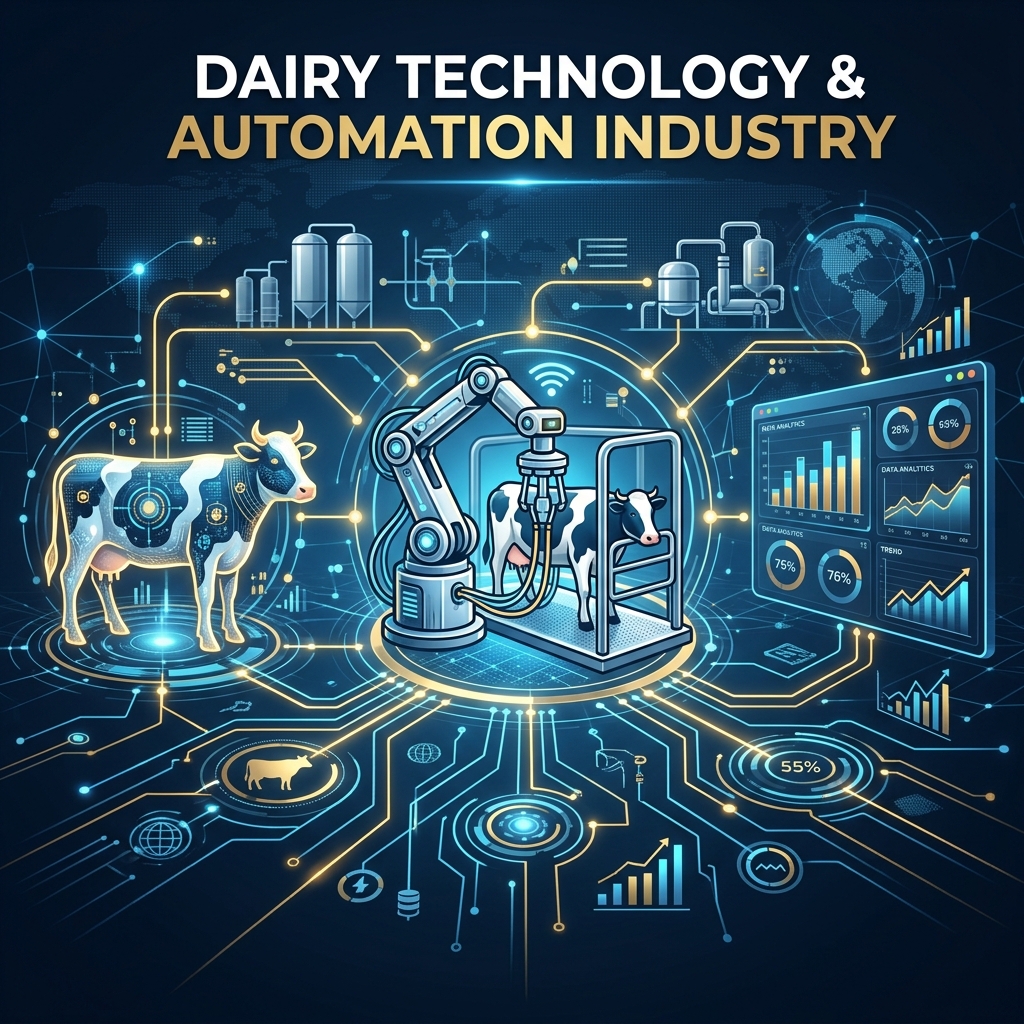
Smart dairy sensors and AI algorithms monitor cow health, rumination, and milking efficiency around the clock.
Below are the top 10 applications of AI currently transforming modern dairy operations:
1. AI-Powered Smart Collars and Ear Tags
Activity trackers, rumination sensors, and telemetry collars powered by localized machine learning interpret physical behavior to identify estrus cycles, track digestive patterns, and trigger early veterinary alerts for health anomalies.
2. Machine Learning for Milk Yield Prediction
Predictive modeling systems process historical lactation logs, meteorological trends, and nutritional inputs to construct accurate individual lactation curves, aiding companies like Fonterra and DeLaval in projecting global dairy supply chain outputs.
3. Computer Vision for Mastitis and Lameness Detection
Camera systems mounted at parlor exits leverage spatial mapping and deep neural networks (such as GEA CattleEye) to continuously grade locomotion scores and detect microscopic udder inflammation days before physical signs occur.
4. Automated Feeding Optimization
AI algorithms calculate real-time feed push-back rates and dry-matter intake to formulate Total Mixed Rations (TMR). The system adjusts feed parameters dynamically to minimize wastage and lower input costs.
5. Predictive Herd Health Analytics
Biotech and nutrition developers like Novonesis and DSM-Firmenich utilize predictive analytics to adjust probiotic formulations, helping prevent metabolic issues such as ketosis and subclinical acidosis.
6. AI in Robotic Milking Systems
Voluntary Milking Systems (AMS) like the Lely Astronaut A5 and DeLaval VMS incorporate laser-guided teat detection and robotic positioning powered by dynamic reinforcement learning models for fast, friction-free attachment.
7. Blockchain + AI for Supply Chain Traceability
Integrated supply networks trace liquid milk batches from specific farm gates to retail stores, using AI to match logistics data with temperature control profiles and verify organic or pasture-fed origin claims.
8. AI for Methane Emission Reduction Monitoring
Advanced feeding stations estimate enteric methane concentrations from cows' breath and cross-reference them with ration composition, helping farmers fine-tune feed supplements to minimize greenhouse gas outputs.
9. Smart Barn Environmental Control Systems
Internet of Things (IoT) sensors monitor humidity indices and heat factors in real-time, using AI controllers to modulate fan speeds, misters, and ventilation systems to combat heat stress.
10. AI-Driven Feed Inventory Management
Drones and static optical sensors inspect silage pits, grain silos, and hay stores, feeding the volumetric data into algorithms that calculate dry-matter depletion rates and recommend purchase timelines.